

Table of Contents
- Why Proper PEMF Mat Storage Matters
- What You Need Before Storing Your PEMF Mat
- Step-by-Step Guide: How to Store PEMF Mats Correctly
- Flat Storage vs. Upright Storage: Which Is Safer?
- PEMF Mat Maintenance Tips for Long-Term Storage
- How to Clean Infrared PEMF Mats Before Storing
- PEMF Mat Safety Precautions for Storage Areas
- Space-Saving Hacks for Small Apartments
- Frequently Asked Questions
Last Updated: September 4, 2026
Why Proper PEMF Mat Storage Matters
A PEMF mat is an investment in your daily recovery routine, but how you treat it between sessions determines how long it delivers consistent therapeutic frequency. Improper storage is the leading cause of premature wear, coil damage, and degraded performance.
Proper storage protects the internal wiring and crystal layers that generate the pulsed electromagnetic field and infrared heat.
Proper storage takes about five minutes once you build the habit.
What You Need Before Storing Your PEMF Mat
Before you begin, gather the essentials. Most PEMF mats ship with what you need, including a carrying case and the original packaging, which are ideal for long-term storage.
- Original box or carrying case: Provides protection from dust, moisture, and accidental punctures.
- Clean, dry microfiber cloth: For wiping down the surface after use.
- A cool, dry storage location: Avoid attics, garages, or basements with fluctuating ambient temperature and high humidity.
- Cable ties or velcro straps: To manage the power cable without bending the connector.
Avoid concrete floors and radiators. Choose a spot with stable room temperature, ideally between 60°F and 75°F, away from direct sunlight (energy.gov).
Step-by-Step Guide: How to Store PEMF Mats Correctly
This is the routine we recommend after every recovery session. Following these steps consistently prevents the most common causes of mat failure.
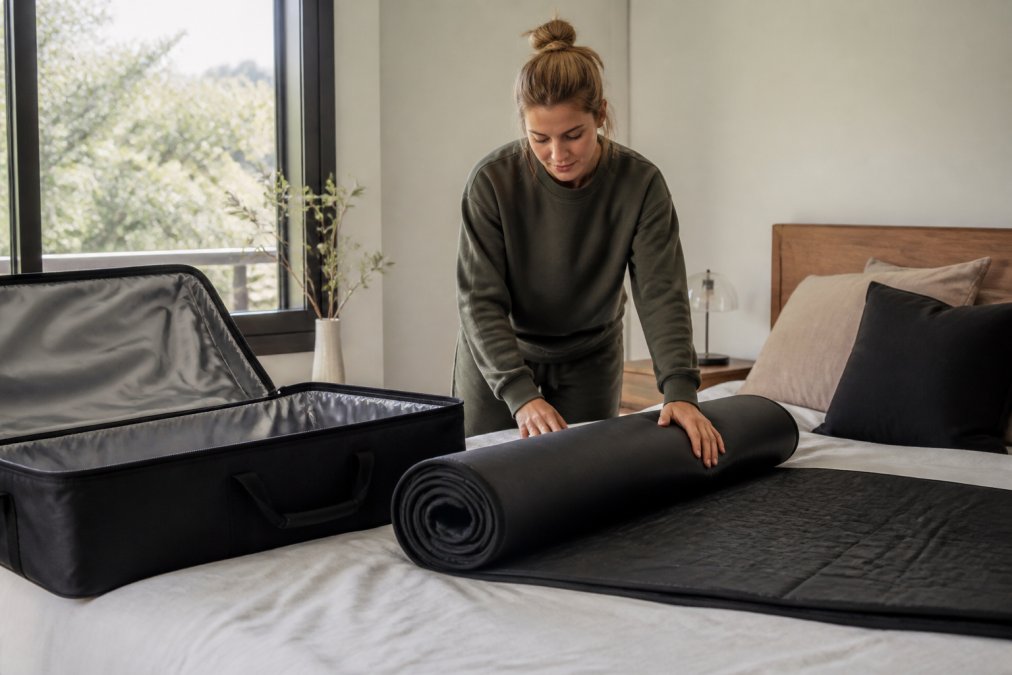
Step 1: Power Down and Unplug
Turn off the control unit first, then unplug the power adapter from the wall outlet. Never pull the cable by the cord. Wait 30 seconds to confirm the device is fully powered down before handling the mat.
Step 2: Cool Down Period and Cleaning
Let the mat cool completely before folding or rolling, folding a warm mat can set creases. While it cools, wipe the surface with a dry microfiber cloth to remove oils, lotion, or sweat.
Step 3: Folding or Rolling Techniques
Check your manufacturer's instructions: some mats fold along marked seams, others should only be rolled. For rolling, start at the end opposite the cable connection and roll loosely to avoid stressing the internal coils.
Step 4: Cable Management and Mat Placement
Wrap the power cable loosely and secure it with a velcro strap, leaving the connector free of tension. Place the mat on a clean, dry surface, never on sharp or uneven surfaces. If using the carrying case, position the cable and controller in their designated compartments.
Troubleshooting Storage-Related Damage
Even with careful handling, mistakes happen. Here is what to do if you discover damage after improper storage.
If you find a crease or fold line that was not there before:
- Do not attempt to iron or heat the mat to remove the crease. Heat can melt the internal insulation.
- Lay the mat flat on a hard, level surface for 48 hours. Many minor creases relax on their own as the foam layers regain their shape.
- After 48 hours, run the mat at low intensity for 10 minutes. The gentle warmth helps the outer fabric relax.
- If the crease remains visible after this cycle, contact the manufacturer. A crease that persists indicates potential damage to the internal coil array.
If the mat produces uneven heat or a buzzing sound after storage:
This signals internal coil damage, often from sharp folding or heavy objects on top during storage. Stop using the mat immediately. Do not attempt repairs, amateur fixes can create hot spots. Contact the manufacturer's support line with your model number and storage conditions.
If the controller fails to power on after storage:
Check the cable connection at both ends, then test the wall outlet with another device. If the controller has a removable battery, reseat it. If none of these work, the issue is likely a damaged connector pin from cable tension during storage.
The 5-Minute Pre-Use Check After Storage
Before your first session after any storage period longer than a week, run this quick checklist:
- Visual inspection, Look for punctures, tears, or discoloration.
- Flex test, Gently bend the mat along its natural lines to confirm flexibility.
- Cable check, Inspect the full length of the cable for kinks or exposed wire.
- Dryness test, Touch the surface and the connector area. Any dampness means the mat was stored in a humid environment and needs 24 hours of air drying before use.
- Low-intensity test run, Run the mat for 5 minutes at the lowest setting before your full session.
Flat Storage vs. Upright Storage: Which Is Safer?
Flat storage is generally safest for long-term maintenance, as it distributes weight evenly and prevents stress on fold points. Upright storage works for space-conscious owners but requires the right setup.
| Storage Method | Best For | Key Risk | Recommendation |
|---|---|---|---|
| Flat storage | Long-term storage, daily use | Takes up floor or shelf space | Place on a solid, flat surface away from moisture |
| Upright storage | Small apartments, limited space | Coils can sag or compress over time | Lean against a wall, never fold in half vertically |
| In carrying case | Travel, occasional use | Mat may retain moisture if packed damp | Ensure fully cool and dry before packing |
If storing upright, lean the mat against a wall with the rolled or folded end on the floor, and avoid leaning heavy objects against it. Never store it standing on its edge for extended periods.
PEMF Mat Maintenance Tips for Long-Term Storage
If you are storing your PEMF mat for a month or more, during a long deployment, a seasonal move, or a recovery hiatus, the rules change.
The 30-Day Rule: When Daily Storage Becomes Long-Term
Treat storage longer than 30 days as a distinct protocol. Risks shift from crease prevention to slow environmental degradation: moisture wicking into seams, foam losing rebound, and coil insulation becoming brittle.
For any storage period exceeding two weeks, follow this preparation sequence:
- Full surface sanitation, Wipe the entire mat with a damp microfiber cloth and a mild enzymatic cleaner (like Simple Green) to remove body oils that become acidic over time. Pay special attention to the edges where sweat pools.
- Complete desiccation, Run the mat unplugged in a dry room (humidity below 50%) for 24 hours before packing. Do not skip this even if the surface feels dry; internal foam layers retain moisture for hours.
- Controlled environment selection, Choose a storage spot with stable temperatures between 60°F and 75°F. Avoid garages where summer heat can exceed 100°F, which can soften the adhesive holding the coil array in place, and avoid basements where winter humidity can exceed 65%, which invites mold into the fabric layers.
Battery and Controller Care for Extended Storage
If your controller uses a rechargeable lithium-ion battery, do not store it at full charge or fully depleted, cells degrade fastest at extremes (batteryuniversity.com). The ideal storage charge is between 40% and 60%.
Before long-term storage:
- Charge the controller to approximately 50%.
- Power the unit off completely.
- Disconnect the controller from the mat if your model allows it.
- Store the controller separately in a padded compartment, never wrapped in the power cable.
A common failure is leaving the controller plugged into the mat in a hot closet; over months, the battery can swell and warp the housing. Check monthly for bulging, if you notice it, do not use the device; contact the manufacturer.
Monthly Inspection Protocol
For storage beyond 30 days, set a recurring calendar reminder to inspect the mat. The inspection takes two minutes:
- Visual surface check, Look for discoloration, sticky spots, or powdery residue, which indicate material breakdown.
- Flex test, Gently flex the mat along its natural fold lines. If you hear crackling or feel resistance, the internal layers may be sticking together.
- Cable and connector check, Inspect the cable for kinks and the connector for corrosion. Green or white residue on the pins indicates moisture exposure.
The 10-Minute Refresh Cycle
For storage beyond 60 days, run the mat at the lowest intensity for 10 minutes. This drives out residual moisture and keeps internal capacitors and circuitry exercised, a low-cost insurance policy against component stagnation.
What Not to Do for Long-Term Storage
- Do not vacuum-seal the mat. Compression can permanently deform the internal layers.
- Do not store it under a heavy mattress. The weight compresses the coil array over months.
- Do not leave it in a car trunk. Temperature swings in a parked car can exceed 60°F in a single day, which accelerates material fatigue.
- Do not use plastic garbage bags. They trap moisture. Use the original carrying case or a breathable cotton storage bag.
How to Clean Infrared PEMF Mats Before Storing
Cleaning your infrared PEMF mat before storage removes residues that can attract dust, harbor bacteria, or degrade the surface material. The right method depends on whether your mat has a removable cover.

For removable covers, machine wash on a gentle cycle with cold water and air dry completely, never use a dryer, as heat can shrink the fabric. For the mat itself, wipe with a damp cloth and mild soap, avoiding saturation and the cable ports.
For mats without removable covers, use a slightly damp microfiber cloth with mild detergent, then a dry cloth. Air dry fully for several hours before storing. Avoid harsh chemicals, bleach, or abrasive cleaners.
PEMF Mat Safety Precautions for Storage Areas
Where you store your PEMF mat matters for both device longevity and household safety. The location should be out of high-traffic areas to prevent tripping hazards and accidental damage.
Keep the mat and cables away from pets and children, pets may chew the power cable, posing an electrical hazard. Store in a closed cabinet, closet, or carrying case, and never leave it plugged in and unattended on the floor.
Moisture control is another critical safety factor. Never store the mat in a damp basement, near a humidifier, or in an area prone to flooding. Excess moisture can compromise the electrical insulation and create a safety hazard during your next recovery session. The U.S. Consumer Product Safety Commission guidance on electrical device safety recommends keeping electrical devices dry and unplugged when not in use.
Space-Saving Hacks for Small Apartments
Living in a small apartment does not mean sacrificing your at-home wellness routine. The key is choosing a storage method that works with your space without compromising the mat's condition.
Store the mat rolled inside its carrying case and tucked under a sofa or bed, measure clearance first, as rolled diameters are several inches. A foldable mat like the Infrared PEMF Go Mat fits tight spaces more easily than a rigid panel.
Repurpose a slim storage ottoman or bench that doubles as seating. Roll the mat in a breathable storage bag and keep it near your recovery area, accessible yet protected from dust.
For daily use, leave the mat flat on a dedicated surface rather than packing it away each time, this reduces wear from repeated folding.
Check mat dimensions and weight before purchasing, the Infrared PEMF Pro Mat weighs approximately 45 lbs, so plan your storage location first.

Storing your PEMF mat correctly is a small habit that pays off in device longevity and consistent performance. Whether you use flat storage for daily access or upright storage to save space, the principles remain the same: keep it cool, clean, dry, and free from pressure points. Essential Life Vitality designs our PEMF mats for durability and ease of use.
Frequently Asked Questions
Can you fold a PEMF mat for storage?
Most PEMF mats should not be tightly folded because sharp creases can damage the internal copper coils over time. Gentle rolling is the safest method for models with a foldable design. If your mat came with a carrying case, use it to maintain the correct shape and protect the surface. Check your user manual for specific guidance on your model. When in doubt, store the mat flat or loosely rolled rather than creating a sharp bend.
Should I unplug my PEMF mat when not in use?
Yes, always unplug your PEMF mat when it is not in use. This is a key PEMF mat safety precaution that prevents electrical issues and protects the internal components from power surges. Unplugging also eliminates any risk of accidental activation, which matters if you store the mat where pets or children could reach the controller. Wrap the power cable loosely and secure it with a velcro strap to prevent damage.
Is it safe to store a PEMF mat in a closet?
Yes, a closet can be a safe storage spot if the environment is clean and dry. Avoid closets near water heaters, in damp basements, or in unconditioned attics where temperature and moisture fluctuate. High humidity can affect the electronics, and extreme ambient temperature can damage the materials. Before placing your mat in a closet, ensure the storage surface is clean and that you have applied proper moisture control, such as a silica gel packet.
How do I clean my PEMF mat before storing it?
To clean infrared PEMF mats, first unplug the device and let it cool completely. Wipe the surface with a soft, slightly damp cloth using mild soap and water. Do not soak the mat or use harsh chemical cleaners. For mats with a removable cover, wash the cover according to the manufacturer's instructions. Ensure the mat is completely dry before rolling it for storage to prevent mold and mildew. Never submerge the mat or its controller in water.
This article was written using GrandRanker