

Table of Contents
- What Is Irradiance in Red Light Therapy?
- How Irradiance Is Measured: Understanding mW/cm²
- Power Density vs Irradiance: What's the Difference?
- Optimal Distance for Red Light Therapy and Light Intensity
- Red Light Therapy Dosage Guide: Finding Your Effective Range
- Why Irradiance Matters: Therapeutic Window and Biological Response
- How to Verify Irradiance Claims and Calibrate Your Device
- Common Misconceptions About Light Power and Safety
- Frequently Asked Questions
Last Updated: September 2, 2026
What Is Irradiance in Red Light Therapy?
Irradiance is the amount of light energy delivered to a specific area of your skin, measured in milliwatts per square centimeter (mW/cm²). It's the intensity or power density of light hitting your tissue at any given moment. Understanding irradiance is essential because it directly determines whether your treatment produces meaningful biological results.
Red light therapy works by exposing your skin to specific wavelengths of light, typically between 600 and 1,000 nanometers (peer-reviewed research). These photons penetrate tissue and interact with mitochondria, the energy-producing structures in your cells. But photons only trigger biological response when they arrive with sufficient intensity. Low irradiance means fewer photons hitting your tissue per second, resulting in weaker cellular stimulation.

The difference between a device that delivers 50 mW/cm² and one that delivers 200 mW/cm² isn't just a number, it's the difference between a treatment that produces measurable results and one that produces mostly heat and marketing claims.
At Essential Life Vitality, we focus on transparency about irradiance specifications because it's the single most important metric for evaluating red light therapy devices. When you're considering a panel for home use, the irradiance rating tells you whether you're getting genuine therapeutic output or paying for a glorified heat lamp.
How Irradiance Is Measured: Understanding mW/cm²
Irradiance measurement uses a standardized unit: milliwatts per square centimeter (mW/cm²). This unit tells you how many milliwatts of light energy are concentrated on each square centimeter of tissue.
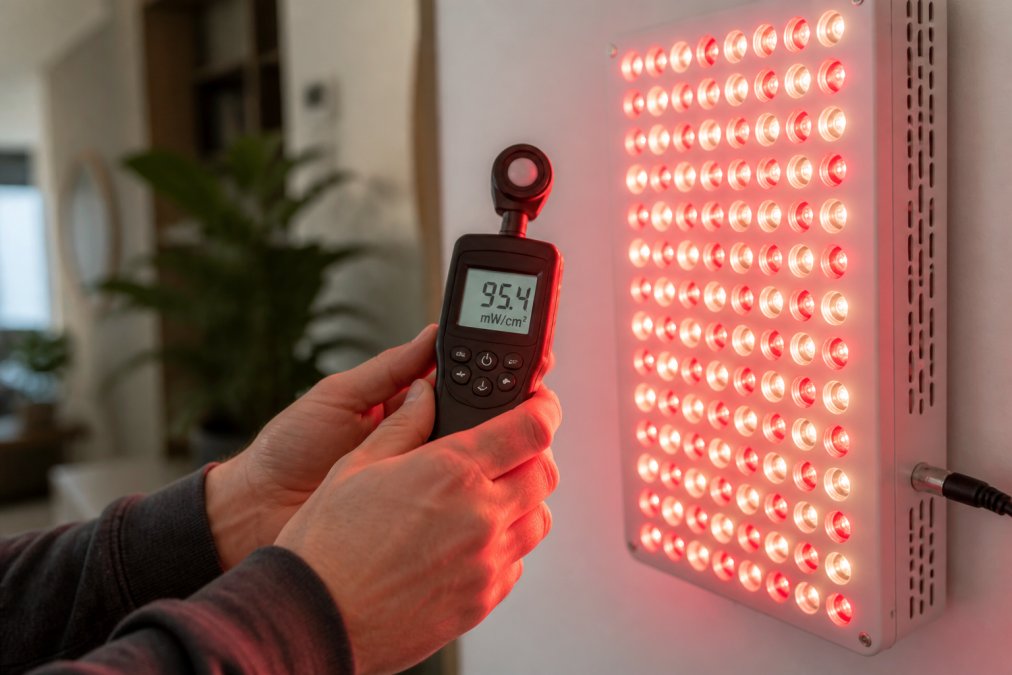
To measure irradiance accurately, technicians use a specialized instrument called an irradiance meter. This device captures photons and converts them into an electrical signal, displaying as mW/cm² on the meter's screen. The measurement is taken perpendicular to the light source at a specific distance, usually 6 inches or 12 inches.
Irradiance decreases as you move away from the light source. A panel delivering 100 mW/cm² at 6 inches might deliver only 50 mW/cm² at 12 inches. This relationship follows the inverse square law. The key point is that irradiance is always distance-dependent, so any legitimate specification must include the measurement distance.
Most therapeutic red light therapy devices deliver between 50 and 200 mW/cm² (peer-reviewed research). Devices under 50 mW/cm² typically produce minimal biological effect. For home use, the sweet spot is typically 100-150 mW/cm² at treatment distance.
Power Density vs Irradiance: What's the Difference?
Many people use the terms "power density" and "irradiance" interchangeably, but they're technically different concepts.
Power density refers to the total optical power output of a device divided by its surface area. This is a device-level specification.
Irradiance is what your tissue actually receives, the light intensity at your skin surface, measured at a specific distance from the device. A panel with high power density might deliver lower irradiance if you're sitting far away from it.
The practical difference: power density tells you about the device's engineering. Irradiance tells you about the treatment you're getting. When shopping for red light therapy panels, focus on irradiance specifications at your intended treatment distance, not power density.
Some manufacturers blur this distinction intentionally, listing high power density figures while leaving irradiance vague. A responsible manufacturer will specify irradiance at multiple distances, 6 inches, 12 inches, and 24 inches, so you can predict what you'll receive at home.
Optimal Distance for Red Light Therapy and Light Intensity
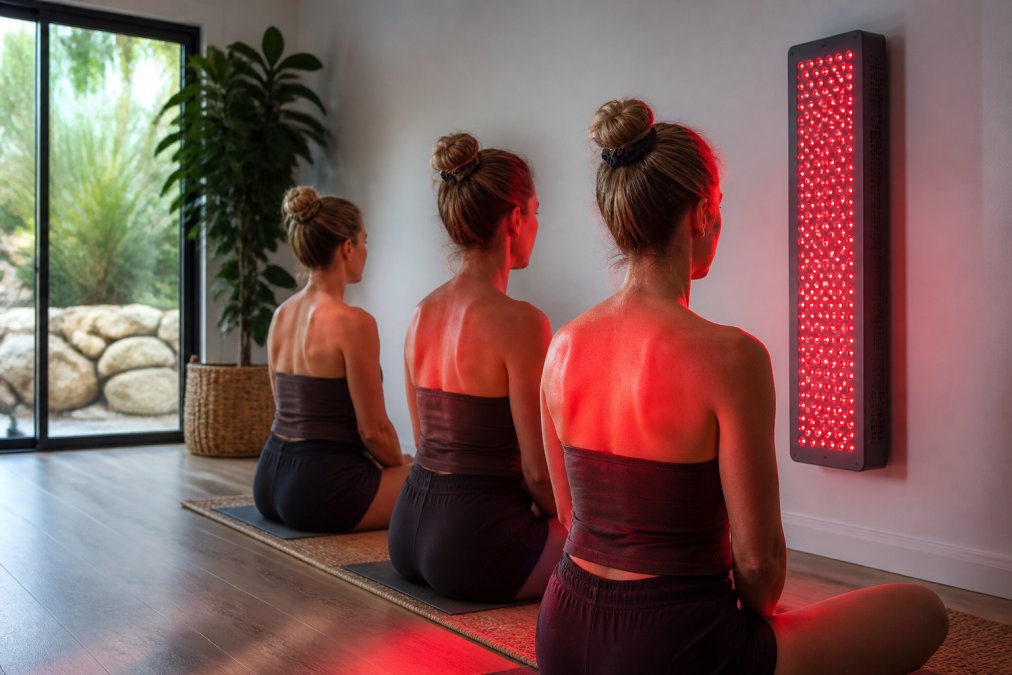
The distance between your skin and the light source is the most underestimated variable in red light therapy. Move closer, and irradiance increases dramatically. Move back, and it drops just as fast.
Most clinical research on red light therapy was conducted at specific distances, typically 4 to 12 inches from the skin, delivering irradiance levels between 100 and 200 mW/cm². If you're sitting 24 inches away from your panel, you're operating outside the researched range.
For athletes using red light therapy for muscle recovery, the typical recommendation is to position the panel 6 to 12 inches from the target area. For facial treatments, many people use panels at 6 to 8 inches. For whole-body panels, the optimal distance depends on the panel's power output and desired coverage area.

The Inverse Square Law in Practice
The inverse square law states that light intensity decreases proportionally to the square of the distance from the source. If you double your distance from a light panel, the irradiance drops to one-quarter of its original value.
Suppose a panel delivers 200 mW/cm² at 6 inches. At 12 inches (double the distance), it delivers approximately 50 mW/cm². At 18 inches, it drops to about 22 mW/cm². This relationship is consistent and predictable, which is why distance is critical for positioning your device correctly.
Red Light Therapy Dosage Guide: Finding Your Effective Range
Dosage in red light therapy is typically expressed as fluence, measured in joules per square centimeter (J/cm²). Fluence is the total light energy delivered over a treatment session, calculated as irradiance multiplied by exposure time. A 20-minute session at 100 mW/cm² delivers approximately 120 J/cm² of fluence.
Most published research suggests that therapeutic effects begin around 4 J/cm² and continue through approximately 50 J/cm² (peer-reviewed research). Below 4 J/cm², you're unlikely to see significant biological response. Above 50 J/cm², you enter diminishing returns.
For muscle recovery, many athletes use protocols in the 20-40 J/cm² range over 10-20 minute sessions. For skin health, lower doses of 10-20 J/cm² are often effective. You can achieve the same fluence with different combinations of irradiance and time, a 10-minute session at 50 mW/cm² or a 30-minute session at 17 mW/cm² both deliver 30 J/cm². For home use, shorter, more intense sessions are typically more practical.
Why Irradiance Matters: Therapeutic Window and Biological Response
Your cells respond to light within a specific intensity range, the therapeutic window. Below this window, the light is too weak to trigger meaningful cellular changes. Above it, you risk tissue heating without additional benefit.
The therapeutic window for red and near-infrared light (wavelengths 600-1,000 nm) is roughly 10-200 mW/cm². Within this range, photons penetrate your skin and reach mitochondria, where they interact with cytochrome c oxidase. This interaction increases ATP production, cellular energy, which supports recovery, reduces inflammation, and promotes tissue repair.
Below 10 mW/cm², photon density is too low for consistent cellular response. Above 200 mW/cm², you're primarily heating tissue rather than triggering photochemical responses. A device claiming "clinical-grade" performance but delivering only 30 mW/cm² at treatment distance is operating below the therapeutic window.
Consistency matters more than occasional high-intensity sessions. A 15-minute daily session at 100 mW/cm² produces more reliable results than a weekly 60-minute marathon session, because your cells respond to regular stimulation within the therapeutic window.
How to Verify Irradiance Claims and Calibrate Your Device
Manufacturers make claims about irradiance, but how do you verify them? The answer is straightforward: measure them yourself using an irradiance meter.
A quality irradiance meter costs between $100 and $300. Meters designed for red and near-infrared light are available from scientific supply companies and specialized retailers.
To measure irradiance accurately:
- Set up your device in the position you'll use it.
- Allow the device to warm up for 2-3 minutes before measuring.
- Position the meter perpendicular to the light source, facing directly toward the panel.
- Place the meter at your intended treatment distance and measure at multiple distances (6, 12, 18, 24 inches).
- Record the reading and compare to manufacturer claims.
Most high-quality devices from reputable manufacturers deliver irradiance within 5-10% of their published specifications. If you find a 30% discrepancy, the device may have a manufacturing defect.
Common Misconceptions About Light Power and Safety
Several misconceptions about red light therapy irradiance persist, often driven by marketing rather than physics.
Misconception 1: More irradiance is always better. Irradiance above 200 mW/cm² primarily generates heat without additional therapeutic benefit. A consistent 100 mW/cm² for 15 minutes is more effective than 300 mW/cm² for 2 minutes.
Misconception 2: Red light therapy damages eyes. Red light itself is safe for eyes within the therapeutic window. The concern arises with direct viewing of high-irradiance sources, particularly near-infrared light. Most home-use devices are safe for incidental eye exposure.
Misconception 3: Irradiance is the only factor that matters. Wavelength, exposure time, and frequency of treatment also matter significantly. A 660 nm red light and an 850 nm near-infrared light have different tissue penetration profiles and biological effects.
Misconception 4: Cheap panels deliver the same results as expensive ones. Price and irradiance don't always correlate perfectly, but they usually do. Cheap panels often use lower-quality LEDs with inconsistent spectral output. More expensive panels typically deliver more consistent irradiance and longer lifespan.
Misconception 5: You need to measure irradiance yourself. While self-measurement is valuable for verification, reputable manufacturers provide detailed irradiance specifications at multiple distances and often include third-party testing reports.
Red light therapy irradiance explained is the foundation for making informed decisions about which devices actually work and which are marketing hype. When you understand irradiance, you can evaluate claims critically, position your device correctly, and optimize your treatment protocol for real results.
Essential Life Vitality's red light therapy panels are engineered with transparency in mind. Each device includes detailed irradiance measurements at standard distances, so you know exactly what you're getting. Whether you're an athlete optimizing recovery or someone managing chronic discomfort, understanding the irradiance your device delivers is the first step toward building an effective home wellness routine.
Consider our Red Light wellness, Red near Infrared LED Panel, 72 Quad Chip Flicker Free Leds, Ultra Series, Clinical Grade Device - Popular for $429.00, designed for at-home light exposure with advanced LED technology and customizable settings. For a full-body experience, explore the Full-Body Dual-Chip Clinical-Grade Red Light Therapy Panel (SAK63480) at $2,499.97. We also offer the Illuminate Red V2 - Red Light Therapy Panel for $2,295.00, engineered for faster, more effective treatments. For targeted facial therapy, the VISO Red Light Therapy Mask | FDA 510(k) Cleared is available for $479.00.

SHOP NOW
Frequently Asked Questions
What irradiance level is best for red light therapy?
Effective irradiance typically ranges from 20 to 200 mW/cm² depending on your goals and tissue depth. For skin and surface treatments, 50-100 mW/cm² works well; for deeper tissue recovery, 100-200 mW/cm² is often used. The optimal level also depends on exposure time—higher irradiance with shorter sessions can match lower irradiance with longer sessions in total energy delivery (fluence). Always start conservatively and adjust based on your response.
How does distance from the device affect red light therapy irradiance?
Distance dramatically affects irradiance due to the inverse square law. If you double your distance from the panel, irradiance drops to one-quarter. For example, a panel delivering 100 mW/cm² at 6 inches may deliver only 25 mW/cm² at 12 inches. Check your device's irradiance chart to find the distance that delivers your target power density. Consistent positioning is critical for repeatable, effective sessions.
What is the difference between power density and irradiance in red light therapy?
Power density and irradiance are often used interchangeably in red light therapy—both describe light intensity measured in mW/cm². Technically, irradiance is the instantaneous power hitting a surface per unit area, while power density is a broader term. For practical purposes, when you see mW/cm² on a red light therapy device, you're looking at irradiance (or power density), which tells you how much light energy reaches your skin per square centimeter per second.
Can red light therapy irradiance be too high for skin health?
Yes. Excessive irradiance can cause skin irritation, temporary redness, or discomfort without improving results. Most clinical research supports 20-200 mW/cm² as safe and effective. Beyond 200 mW/cm² for extended periods, you risk heat buildup and diminishing returns on biological response. The therapeutic window exists for a reason—more light doesn't always equal better outcomes. If your skin feels irritated after sessions, reduce irradiance or shorten exposure time.
This article was written using GrandRanker