

Table of Contents
- Red Light Therapy: A Buyer's Framework for 2026
- How to Choose Red Light Therapy: A Comparison Table
- Red Light Therapy Wavelength Chart: 660nm vs 850nm
- Irradiance and Power Density: The Real Test of Quality
- Panel Size vs. Handheld: Matching Device to Treatment Goals
- Red Light Therapy Treatment Duration and Dosage
- Safety, EMF Emissions, and Objective Testing
- Conclusion: Your Verification-First Checklist
- Frequently Asked Questions
Last Updated: September 7, 2026
Red Light Therapy: A Buyer's Framework for 2026
Red light therapy is a non-invasive treatment that delivers specific wavelengths of light to stimulate cellular energy production. The market has exploded with panels, masks, and handheld devices, yet most buyers struggle to separate genuine clinical-grade hardware from marketing hype. This guide gives you a verification-first framework for how to choose red light therapy equipment.
The single most important shift in 2026 is this: buyers are moving away from brand loyalty and toward spec-sheet literacy. Understanding irradiance, wavelength purity, and duty cycle matters more than any logo. Below, we'll show you how to audit a product's technical claims, what numbers matter, and which red flags signal a device that may underperform.
Why Most Panels Fail to Deliver Results
Some panels may advertise the right wavelengths but deliver inadequate power density at the skin surface. A device can list 660nm and 850nm emitters yet produce an irradiance so low that a 20-minute session may deliver a negligible therapeutic dose. Manufacturers often quote LED chip power rather than measured output at a practical treatment distance, which can create a gap between expectation and reality.
Another common factor is beam angle and array density. Widely spaced LEDs with narrow beam angles can create "hot spots" and uneven coverage, meaning parts of your target tissue may receive therapeutic light while others get less. This can lead to inconsistent outcomes.
How to Choose Red Light Therapy: A Comparison Table
The fastest way to evaluate any device is to compare its core specifications against your treatment goals. The table below summarizes the key decision points you will face when selecting a unit.
| Device Type | Typical Power Density | Best For | Session Time | Price Range |
|---|---|---|---|---|
| Full-Body Panel | 50-150 mW/cm² | Whole-body recovery, muscle groups | 10-20 min | $429 - $2,500 |
| Face Mask | 30-60 mW/cm² | Skin rejuvenation, acne | 5-10 min | $479 |
| Handheld Device | 50-100 mW/cm² | Targeted joints, small areas | 5-15 min | $69 - $300 |
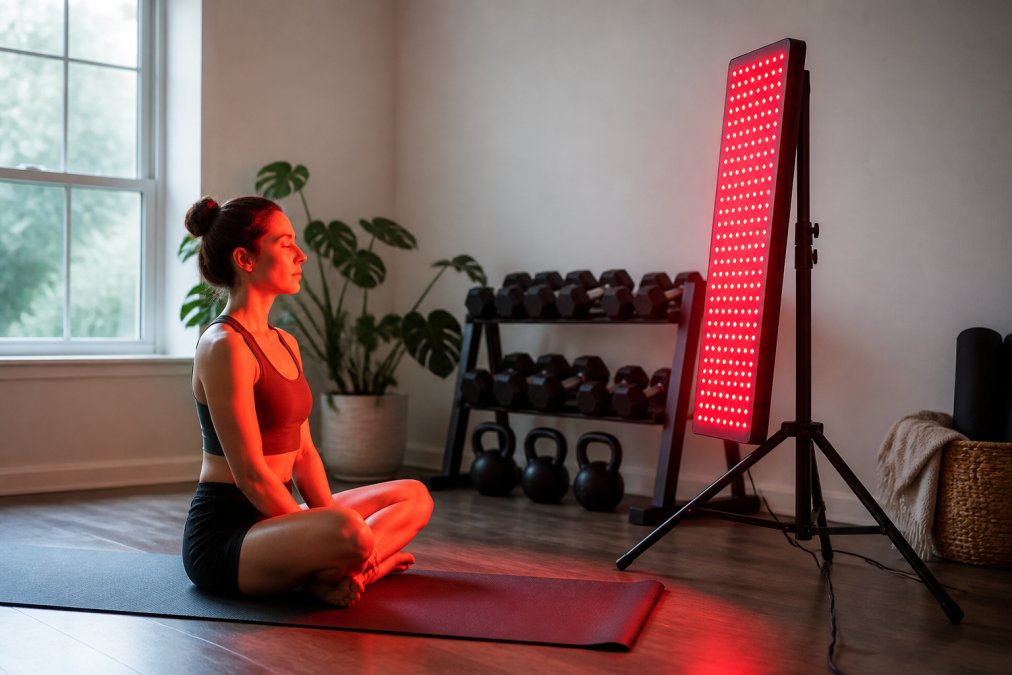
Your choice of red light therapy device should start with the treatment area, not the price tag. A full-body panel like the Full-Body Dual-Chip Clinical-Grade Red Light Therapy Panel covers large muscle groups efficiently, while a mask or handheld targets the face or specific joints with less energy waste.
Red Light Therapy Wavelength Chart: 660nm vs 850nm
A red light therapy wavelength chart typically shows two dominant peaks: 660nm in the visible red spectrum and 850nm in the near-infrared range. Red light at 660nm penetrates the skin to about 2-3 millimeters, making it ideal for surface-level concerns like skin rejuvenation and wound healing (peer-reviewed research). Near-infrared at 850nm reaches deeper into muscle tissue, joints, and bone, which is why it dominates protocols for muscle recovery and joint pain relief.

Decoding the Therapeutic Window
The therapeutic window spans roughly 600-1000 nanometers, but not all wavelengths perform equally. Clinical research has concentrated on the 630-680nm and 800-880nm bands because these align with the absorption peaks of cytochrome c oxidase, the key enzyme in mitochondrial function. When this enzyme absorbs photons, it triggers a cascade that increases ATP production and cellular energy.
For most home users, a dual-wavelength panel is the pragmatic choice. You get the surface benefits of 660nm red light and the deep-tissue effects of 850nm near-infrared in a single session. Single-wavelength devices force you to choose between skin health and muscle recovery, an unnecessary compromise for the price most panels command.
Irradiance and Power Density: The Real Test of Quality
Irradiance, measured in mW/cm², is the most important specification on any red light therapy device because it determines the actual dose your tissue receives. Fluence, measured in J/cm², is the total energy delivered over your session time. Without adequate irradiance, you cannot reach therapeutic fluence within a practical session duration.
A common mistake is comparing devices solely on total LED count or wattage. A panel with 1,000 low-quality LEDs spaced far apart can deliver less usable irradiance than a panel with 300 high-output LEDs arranged in a dense array. The quad-chip design seen in the Red Light wellness, Red near Infrared LED Panel, 72 Quad Chip Flicker Free Leds, Ultra Series packs multiple emitters per chip, increasing power density and improving beam uniformity.
Panel Size vs. Handheld: Matching Device to Treatment Goals
Panel size determines how much of your body you can treat in a single session, and this should drive your decision more than any other factor. Full-body panels, ranging from roughly 12 x 36 inches to larger formats, allow you to treat your entire torso, back, and limbs without repositioning. This efficiency matters for athletes and biohackers who want daily full-body exposure of red light therapy without spending 45 minutes moving a small device across each muscle group.
Handheld devices and smaller panels excel at targeted therapy for specific joints, the face, or localized areas of chronic muscle soreness. They are also more portable and easier to store, appealing to apartment dwellers or frequent travelers. The tradeoff is session time: treating a full back with a 6 x 8 inch panel requires multiple overlapping passes that extend your routine considerably.
For most buyers, the decision comes down to consistency. A full-body panel that you use for 15 minutes daily will outperform a more powerful handheld that you skip because it takes too long. Consider your living space, your schedule, and whether you will maintain the treatment frequency the protocol requires.
The Longevity Question: What Happens After 3 Years?
Here is a question almost no buying guide asks: what happens when your device needs maintenance? Red light therapy panels are a significant investment, full-body units typically range from $429 to $2,500, yet most manufacturers provide little information about the expected lifespan of their components or support after the first year.
LED lifespan: Quality LEDs used in clinical-grade panels are typically rated for 50,000 hours of operation (energy.gov). At 20 minutes per day, that translates to over 400 years of daily use. In practice, LEDs do not fail completely; they gradually lose output. Most LEDs maintain 70% of their original output (the L70 standard) for their rated lifespan. A panel you buy today will likely still deliver output a decade from now, assuming the driver and cooling system hold up.
Driver and power supply: The LED driver is the component most likely to fail. It converts wall power to the constant current that LEDs require. Quality drivers from brands like Mean Well are rated for 50,000+ hours and are replaceable. Cheaper, unbranded drivers may fail in 2-3 years. Before buying, ask whether the driver is a standard off-the-shelf component or a proprietary part.
Cooling fans: If your panel has active cooling, the fan is a wear item. A quality dual-ball-bearing fan rated for 50,000 hours will outlast a sleeve-bearing fan rated for 10,000-20,000 hours. Fan failure does not damage the LEDs immediately, but it can accelerate heat buildup, which may shorten LED lifespan and reduce output.
Warranty and Support Expectations
Warranty terms vary widely across the industry. A 1-year warranty is common on budget devices, while premium manufacturers typically offer 2-3 years on the full unit and up to 5 years on LEDs. When comparing devices, look beyond the headline warranty period and check:
- What is covered: Does the warranty include the LED array, or only the housing and electronics?
- Shipping costs: Who pays for return shipping if a repair is needed?
- Replacement policy: Does the manufacturer repair the unit or send a replacement?
- Support availability: Is there a phone number, or only email? What is the typical response time?
Making the Final Size Decision
If you are still deciding between a full-body panel and a handheld, run this quick mental test. Imagine your ideal week: how many days will you realistically use the device? If the answer is 4 or more, a full-body panel may offer benefits in convenience and consistency. If you plan to use it 1-2 times per week for a specific joint or the face, a handheld or mask is the more rational purchase. The best device is the one you will actually use consistently for the next 12 months.
Red Light Therapy Treatment Duration and Dosage
Red light therapy treatment duration follows a simple principle: enough time to reach a desired fluence, but not so long that you risk overstimulation. For a panel delivering 50-100 mW/cm² at your treatment distance, a session of 10-20 minutes may provide a target dose. Facial masks with lower irradiance often require shorter sessions of 5-10 minutes because they sit directly on the skin.
Consistency matters more than session length. Most protocols recommend 3-5 sessions per week for the first 4-8 weeks, followed by a maintenance schedule of 2-3 sessions weekly. Some users report noticing changes in skin tone and muscle soreness within a few weeks, while deeper tissue changes may take 8-12 weeks of regular use.
Safety, EMF Emissions, and Objective Testing
Safety in red light therapy extends beyond skin sensitivity. The two technical factors that separate a well-engineered device from a problematic one are electromagnetic field (EMF) emissions and heat dissipation. Most buying guides skip both, yet they can affect your comfort and long-term health, especially if you plan daily 20-minute sessions.
EMF Emissions: What to Look For
All electronic devices emit some level of EMF. The concern with red light panels is that poor shielding or low-quality drivers can produce elevated readings at the treatment distance where you sit or stand. For most people, this is a non-issue, but for some individuals with electromagnetic hypersensitivity, it can mean headaches, fatigue, or tingling during use.
When evaluating a device, look for one of two things: a published EMF measurement taken at a realistic distance (6-12 inches), or a design that explicitly uses low-EMF drivers and separated power supplies. Panels that keep the power brick external and use DC current to the LED array tend to produce lower EMF than those with integrated AC-to-DC conversion. If a manufacturer does not publish EMF data and will not provide it upon request, treat that as a yellow flag.
Heat Dissipation and Fan Noise
High-output LED panels generate meaningful heat. A 1,000-watt panel running at full power will warm up significantly, and how that heat is managed determines both component lifespan and user comfort. Passive cooling, large aluminum heat sinks, is silent but limits how densely LEDs can be packed. Active cooling, fans, allows higher power density but introduces noise and a moving part that can fail.
Fan noise is rarely discussed in reviews, but it matters if you plan to use the device while meditating, reading, or watching television. Fan noise is typically rated in decibels (dB). A quiet panel runs at 30-40 dB, comparable to a whisper or a running refrigerator (the CDC). Louder units can hit 50-60 dB, which is distracting in a quiet room. Before buying, check for the dB rating or look for user reviews that mention fan volume. Also consider the fan's expected lifespan, most quality fans are rated for 30,000-50,000 hours, but cheaper sleeve-bearing fans fail sooner than dual-ball-bearing designs.
How to Verify Manufacturer Claims Yourself
Marketing specs are not always accurate. The good news is that you can verify the two most important claims, irradiance and wavelength, with affordable tools and a simple protocol.
Irradiance verification: A solar power meter (available for $30-50 from hardware stores or online) measures power density in mW/cm². To test a panel:
- Place the meter sensor at the exact distance you plan to use during treatment (typically 6-12 inches).
- Point the sensor directly at the LED array.
- Record the reading after 30 seconds to allow the meter to stabilize.
- Compare that number to the manufacturer's published irradiance at the same distance.
A variance of ±10-15% is acceptable due to meter calibration differences. A variance of 30% or more means the marketing spec is inflated.
Wavelength verification: A basic spectrometer or even a narrowband optical filter can confirm the dominant wavelength. This is less critical for most buyers because LED manufacturing is fairly consistent, but if you are buying from an unknown brand, it is worth checking that a device labeled 660nm is not actually emitting at 630nm or 680nm.
The Flicker Factor
Flicker is another quality marker that often goes unnoticed. Many inexpensive panels use pulse-width modulation (PWM) to control brightness, which produces a visible or invisible flicker that may cause eye strain and headaches during 20-minute sessions. Flicker-free drivers, like the ones specified in the Illuminate Red V2, deliver steady, uninterrupted light that may be more comfortable for extended exposure.

To test for flicker, use your phone's slow-motion camera mode. Point it at the panel and record a few seconds of video. If you see visible pulsing or banding in the playback, the device uses PWM and may cause discomfort. Panels using constant-current drivers may eliminate this issue.
By applying this verification-first approach, you move from trusting marketing language to confirming performance with your own measurements. That is the difference between buying a device that looks good on paper and one that may deliver the irradiance, safety profile, and comfort you need for a sustainable routine.
Conclusion: Your Verification-First Checklist
Choosing the right red light therapy device comes down to verifying specifications rather than trusting marketing language. Start by confirming the wavelength (660nm for skin, 850nm for deep tissue), then check the irradiance at a realistic treatment distance. Match the panel size to your treatment goals and your willingness to maintain a consistent schedule. Finally, look for published EMF data, flicker-free drivers, and transparent testing methodology.
Essential Life Vitality offers a curated selection of red light therapy panels with detailed product specifications and dimensions provided on every page, so you can verify the numbers before you buy. Our support team is available via phone, email, or live chat to answer technical questions about irradiance, dosage, and treatment protocols. Get started with Essential Life Vitality and build a disciplined, restorative wellness routine backed by hardware that delivers what it promises.

Frequently Asked Questions
Why don't doctors recommend red light therapy?
Many doctors hesitate to recommend red light therapy because the FDA classifies most devices as general wellness products, not medical treatments. This means manufacturers cannot claim to cure or treat specific conditions like arthritis or depression. Additionally, clinical evidence is still growing, and many physicians are unfamiliar with the technical specs that determine efficacy, such as irradiance and wavelength. When used as a wellness tool for muscle recovery or skin health, it is generally safe, but you should always discuss it with your doctor if you have a specific medical condition or are taking photosensitizing medications.
How do I distinguish between high-quality panels and ineffective red light products?
Look for objective, third-party tested specifications rather than marketing claims. A high-quality panel will clearly state its irradiance in mW/cm² at a specific distance, not just its total wattage. Check for the use of 660nm and 850nm wavelengths, which are within the therapeutic window. Also, look for flicker-free drivers and low EMF emissions. Reputable brands will provide a spec sheet or be willing to share testing data. Be wary of devices that only list LED count or total power, as these numbers do not tell you how much light actually reaches your tissue.
What is the difference between red light and near-infrared light therapy?
Red light (around 660nm) penetrates the skin's surface and is best for skin rejuvenation, reducing fine lines, and improving wound healing. Near-infrared light (around 850nm) penetrates deeper into muscles, joints, and bones, making it more suitable for muscle recovery, reducing inflammation, and relieving joint pain. Many full-body panels combine both wavelengths to address skin and deep tissue concerns simultaneously. If you are targeting skin, prioritize 660nm; for deep muscle recovery, you need a device that emits significant 850nm output.
How much irradiance is necessary for effective red light therapy at home?
For effective at-home sessions, you generally want an irradiance of at least 40 to 100 mW/cm² at your treatment distance. This range allows you to deliver a therapeutic dose of 5 to 10 J/cm² in a reasonable session time of 10 to 20 minutes. Devices with lower irradiance may work, but they require significantly longer sessions to achieve the same fluence, which is often impractical. Check the spec sheet for irradiance at a specific distance, such as 6 or 12 inches, to understand what you are actually getting.
How long should a red light therapy treatment session last?
The ideal red light therapy treatment duration depends on the device's irradiance and your target area. A general guideline is 10 to 20 minutes per session for targeted areas. For example, on a panel delivering 100 mW/cm², a 10-minute session provides a 60 J/cm² dose, which is within the therapeutic range. Treating the whole body may require moving the panel or using a larger device for 15-20 minutes. Consistency matters more than long sessions; daily use for a few weeks is often where you see compounding benefits.